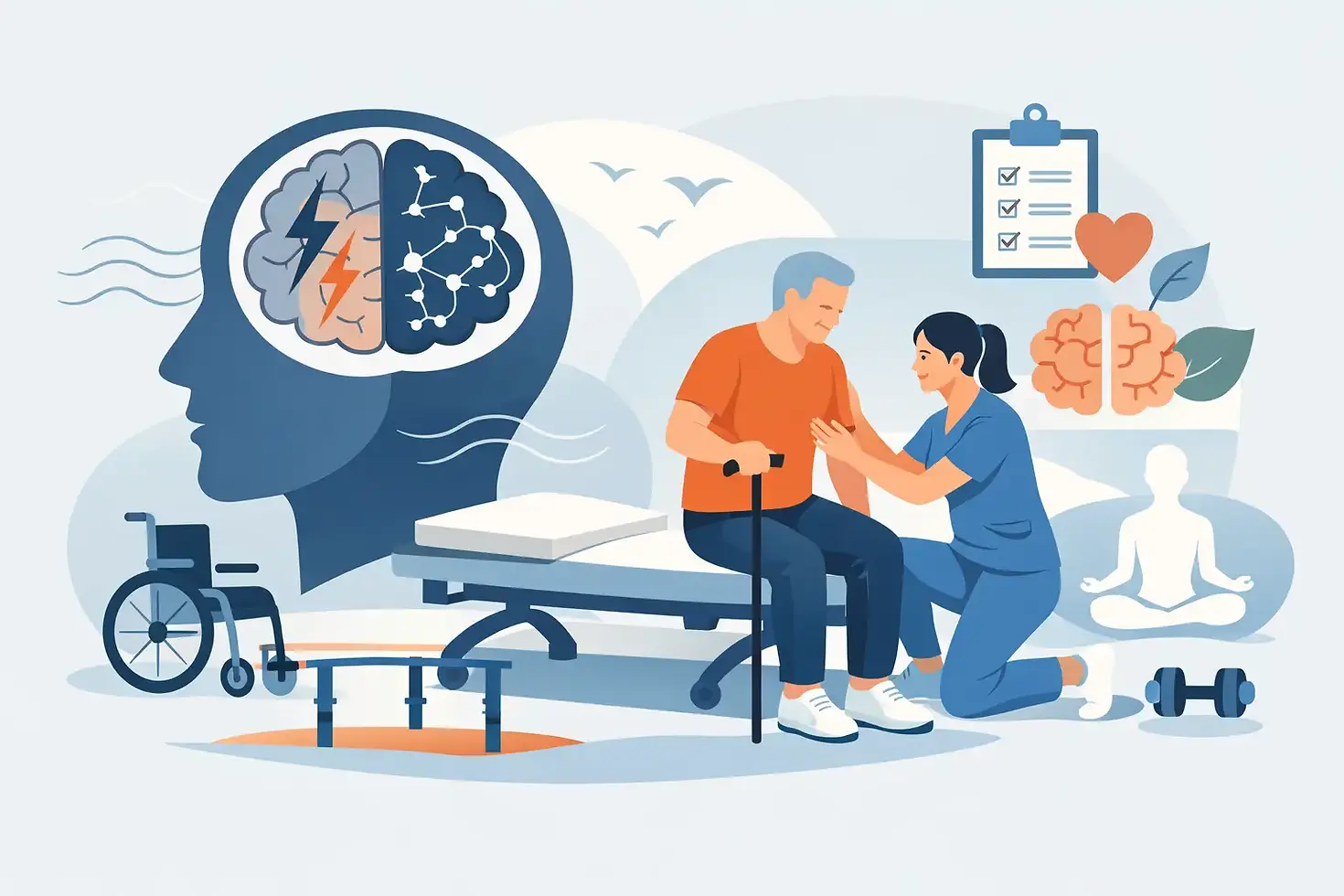
Best Recovery Strategies After Stroke
The hardest part for many stroke survivors is not the hospital stay. It is the quiet stretch after discharge, when weakness, pain, stiffness, speech changes, and fatigue begin shaping daily life. The best recovery strategies after stroke are the ones that continue beyond emergency care and focus on function, repetition, and real-world independence.
Stroke recovery is rarely linear. Some people improve quickly in one area and struggle in another. A hand may stay tight even as walking improves. Speech may return while balance remains unreliable. That is why recovery works best when it is structured, individualized, and sustained long enough to address the complications that often appear after the acute phase.
What makes the best recovery strategies after stroke effective
The most effective strategies share one trait: they are built around the brain and body’s capacity to relearn through repeated, meaningful activity. After a stroke, the nervous system may reorganize, but it needs consistent stimulation. Passive waiting is not a plan. Neither is a short burst of therapy followed by months without support.
Good recovery care targets movement, communication, pain, endurance, and confidence at the same time. It also respects that every survivor starts from a different place. Age, stroke severity, prior health, family support, finances, and access to therapy all influence progress. That does not mean recovery is out of reach. It means the plan has to meet the person, not the other way around.
Start rehab early, but think beyond the first few weeks
Early rehabilitation matters because the body starts adapting immediately. Muscles can weaken, joints can stiffen, and movement patterns can become compensatory if they are not addressed. Even simple tasks such as sitting upright, shifting weight, or standing safely can protect long-term function.
Still, early rehab is only the opening chapter. Many survivors are told they have plateaued when what has really happened is that therapy ended too soon, became too general, or failed to address pain and mechanical restrictions. Recovery can continue for months and often years when treatment remains targeted and practical.
This is especially true for people dealing with lingering arm weakness, foot drop, spasticity, shoulder pain, gait problems, or fatigue that limits consistency. These are not minor side issues. They are often the very barriers that keep someone from cooking, bathing, driving, or returning to work.
Repetition matters more than intensity alone
A demanding session is not automatically a productive one. The brain responds to repetition with purpose. Practicing a transfer from bed to chair ten safe times may matter more than doing a series of exercises that do not connect to daily function. The goal is not just effort. The goal is useful retraining.
Focus on mobility before compensation becomes a habit
Walking again is a major goal after stroke, but quality matters. If a survivor learns to move by hiking the hip, locking the knee, or dragging the foot, those patterns can become ingrained and painful. The same applies to the upper body. A tight shoulder, curled hand, or guarded posture can lead to secondary injuries if ignored.
Mobility work should include balance, gait mechanics, weight shifting, joint range of motion, and trunk control. Core stability is often overlooked, yet it plays a central role in standing, reaching, and safe walking. When the trunk is unstable, the arms and legs have less efficient control.
This is also where hands-on therapeutic care can make a real difference. Manual work aimed at soft tissue restriction, joint stiffness, and postural alignment may help survivors tolerate exercise better and move with less pain. For many patients, progress is limited not just by weakness, but by the stiffness and guarding that build around it.
Do not underestimate pain and spasticity
Pain after stroke is common, and it can derail recovery when treated as an afterthought. Shoulder pain, neck tightness, low back strain, hand stiffness, and leg discomfort often develop as survivors compensate, lose range of motion, or struggle with abnormal tone. Spasticity can further limit movement, hygiene, sleep, and safety.
The best recovery strategies after stroke include active treatment for pain, not just encouragement to push through it. If a movement hurts every time, patients naturally avoid it. Avoidance leads to less use, more stiffness, and greater disability. That cycle must be interrupted early.
Management may include guided stretching, positioning, manual therapy, neuromuscular re-education, splinting in some cases, and careful exercise progression. What works depends on the source of pain. A tight shoulder from poor support is different from central post-stroke pain, and both require a different response.
Pain control should support function
Pain care should never be isolated from rehabilitation goals. The point is not simply to feel better for a few hours. The point is to improve tolerance for walking, dressing, reaching, speaking, or sleeping well enough to participate fully in recovery.
Train the affected side, even when progress feels slow
One of the most discouraging parts of stroke recovery is how slow the affected arm or leg can be to return. Families may stop using that side because it is easier to work around it. That is understandable, but over time it can reinforce neglect and loss of function.
The affected side should be included in safe, regular practice. That may mean supported reaching, guided grasp-and-release tasks, assisted stepping, or sensory retraining. Improvement is often incremental. A little more control, a little less tightness, a little more endurance. Those changes add up.
This is where patients need honest encouragement. Not false promises, but proof that small gains matter. Being able to open the hand enough to clean the palm, stand long enough to brush teeth, or transfer with less help is meaningful progress because it restores dignity and lowers caregiver strain.
Speech, cognition, and swallowing need equal attention
Recovery is not only about walking. Many survivors also face aphasia, memory changes, slowed processing, or swallowing problems. These issues can isolate a person even when physical mobility improves. Someone may look stronger but still struggle to communicate needs, manage medications, or eat safely.
Speech and cognitive rehabilitation should be addressed as early as possible and reinforced at home. Families play a major role here. Short, calm conversations, extra response time, visual cues, and consistent routines can reduce frustration. Recovery tends to improve when the environment supports practice instead of rushing the survivor.
Swallowing changes deserve particular urgency. Coughing during meals, recurrent choking, unexplained weight loss, or a wet-sounding voice after eating should not be ignored. Nutrition and hydration are essential for healing, energy, and endurance.
Build recovery into daily life at home
A therapy session alone is rarely enough. The home environment often determines whether gains hold or fade. Recovery works better when exercises and movement practice are folded into ordinary activities such as standing at the sink, getting in and out of bed, walking short household distances, or using the affected hand during grooming.
Home setup matters too. Clear walking paths, stable seating, bathroom safety supports, and proper limb positioning can reduce falls and pain. Caregivers need instruction, not just good intentions. Poor transfer technique or unsupported limbs can worsen pain, especially in the shoulder and wrist.
For underserved families, affordability and continuity are often the deciding factors. A perfect plan that a household cannot sustain is not a real plan. Community-based, nonprofit, and function-focused care models are critical because stroke recovery should not depend on income alone. Organizations such as CAMED exist to help bridge the gap between discharge and true functional recovery, especially when standard care ends before the patient is ready.
Best recovery strategies after stroke also include emotional recovery
Depression, anxiety, irritability, grief, and fear are common after stroke. These are not signs of weakness. They are predictable responses to sudden loss of function and uncertainty. Emotional health affects motivation, sleep, pain tolerance, and participation in therapy.
Families and clinicians should watch for withdrawal, hopelessness, refusal to practice, or major changes in mood. Support may include counseling, peer connection, caregiver education, and realistic goal setting. Recovery is easier to sustain when the survivor can see what progress means in practical terms.
A good goal is specific and personal. Not “get better,” but “walk safely to the mailbox,” “button a shirt,” or “say my grandchildren’s names clearly.” Goals like these create momentum because they connect therapy to life.
Recovery is strongest when care is consistent
No single treatment is the answer for every stroke survivor. Some need intensive gait work. Some need upper limb therapy and pain relief. Some need speech support and caregiver training more than anything else. The best approach is coordinated, persistent, and responsive to setbacks.
If progress has slowed, that does not always mean the window has closed. It may mean the current strategy is too narrow, too short, or missing a major barrier such as pain, stiffness, fatigue, or poor support at home. Recovery deserves reassessment, not resignation.
Every survivor deserves more than survival. They deserve a real chance to move with greater ease, communicate with confidence, and reclaim the parts of daily life that make independence possible. That chance grows when treatment stays focused on function, dignity, and access long after the hospital doors close.


Comments